



Women in Norteño Music: Breaking Tradition and Making History
For most of its history, Norteño music was a man’s world. The sound of the diatonic accordion leading a corrido or polka through a crowded dance hall was almost always played by a man in a cowboy hat, with a bajo sexto player beside him. Women were part of the culture, of course—they were the dancers, the singers in the audience, the ones filling the halls with life. But stepping on stage, accordion in hand, was another matter entirely.
In recent decades, that picture has begun to change. Women in Norteño music are breaking barriers, claiming space on stage, and inspiring a new generation of musicians. Their journeys tell a story of persistence, talent, and the power of tradition evolving without losing its roots.
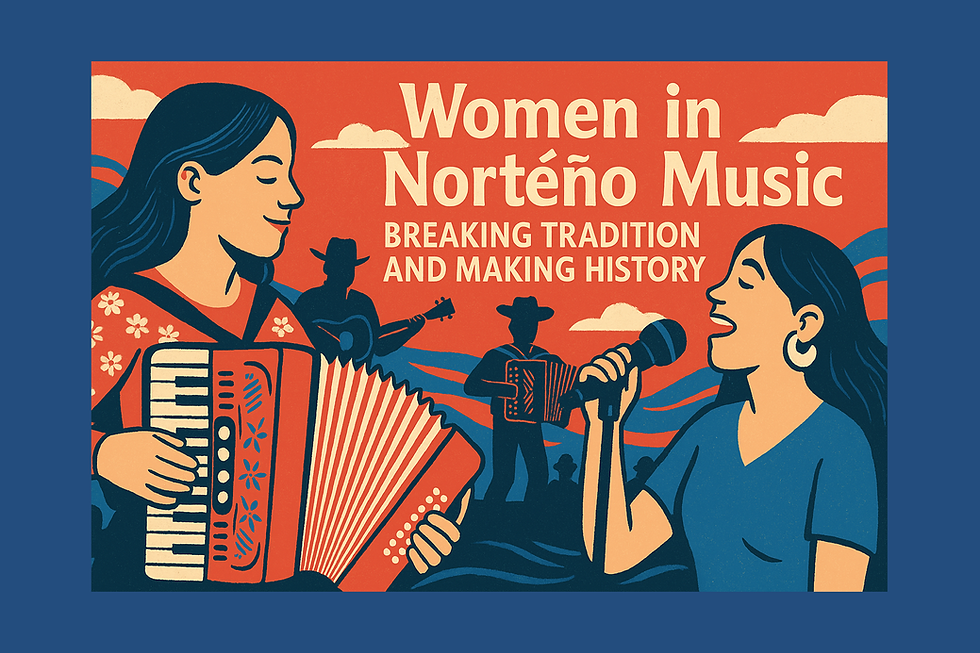
A Tradition Once Closed
The roots of Norteño music run deep in Northern Mexico and South Texas, in small towns where music was handed down like a family heirloom. Fathers taught sons to play the button accordion, uncles passed the bajo sexto to nephews, and the music flowed from kitchens to cantinas to community festivals.
For decades, women rarely crossed the invisible line that kept them off stage. Cultural norms and industry realities made it nearly impossible. Touring life was rough, opportunities were scarce, and promoters weren’t interested in betting on female‑led bands in a genre that had always been marketed as masculine. The music belonged to the men—or so the story went.
And yet, a few women refused to stay in the background. They picked up the accordion, learned the songs by ear, and played anyway.
Eva Ybarra: The Queen of the Accordion
Among the first to truly break through was Eva Ybarra, now celebrated as “La Reina del Acordeón” (The Queen of the Accordion).
Growing up in San Antonio, Texas, Ybarra fell in love with the accordion as a child. In the 1960s and ’70s, when she first began performing, she faced dismissive comments and outright resistance—girls, people said, didn’t play accordion in conjunto or Norteño music. But her skill, creativity, and persistence spoke louder than any stereotype.
Ybarra not only performed in dance halls and festivals across Texas, she innovated within the tradition, blending classic conjunto with her own experimental style. Over time, she earned respect as a band leader, recording artist, and teacher, ultimately becoming the first woman inducted into the Conjunto Music Hall of Fame. Her career opened the door for countless others, proving that talent could defy expectation.
A New Generation: Las Fénix and Beyond
Today, young women in Norteño and Tejano music don’t just exist on the sidelines—they’re front and center. A shining example is Las Fénix, a sister‑led band from Houston, Texas.
Made up of the five Rodríguez sisters, Las Fénix combines tight harmonies, lively showmanship, and traditional Norteño instrumentation with a modern polish that connects to audiences online as well as in person. Their success is fueled not only by talent but also by their ability to bridge the old and new worlds of Norteño music—from live tours and festivals to viral clips on social media.
And they’re not alone. Across TikTok, Instagram, and YouTube, more young women are sharing accordion solos, covers of classic corridos, and original compositions, building audiences that reach far beyond the local dance hall. What once required the approval of a record label or a bar owner now only requires a phone, an instrument, and a story to tell.
Why Their Impact Matters
The rise of women in Norteño music is about more than individual success—it’s about broadening the story of the genre itself.
For young girls and aspiring musicians, seeing women on stage is proof that tradition belongs to everyone.
For the culture, it means the music continues to evolve without losing its roots, carried forward by more voices and perspectives.
And for listeners, it brings a richness and diversity that keeps the genre vibrant, whether they hear it in a local dance hall or on a viral TikTok.
By stepping onto stages and into the digital spotlight, these women ensure that Norteño music remains a living tradition, one that reflects the communities and families that create it.
A Future That’s Wide Open
From Eva Ybarra’s groundbreaking performances to Las Fénix’s modern stage presence, women in Norteño music have proven that talent and passion will always find a way through tradition’s old gates.
And if you listen closely—to the bustling fairs, the wedding parties, or the phone screens lighting up with a 15‑second accordion solo—you can hear something new in the music:
It’s the sound of a tradition that’s growing, welcoming new voices without losing its heartbeat.


Comments